
May 13, 2026

— 9 Minute · May 13, 2026
Couscous Fridays: The Meal That Holds Morocco Together
Every Friday across Morocco, families gather around a single massive platter of hand-rolled couscous. The tradition is older than the nation itself, and it reveals more about Moroccan identity than any monument ever could.
There is a moment, every Friday around one in the afternoon, when the streets of Moroccan cities grow quiet. Shops pull down their metal shutters. Taxi drivers park and disappear. The call to prayer has come and gone, and now something older than any mosque takes hold: the weekly couscous.
The tradition is so deeply embedded in Moroccan life that to skip Friday couscous is not merely unusual, it borders on the suspicious. As the British-Egyptian food historian Claudia Roden wrote in The Food of Morocco, the Friday couscous is "a national institution that transcends class, region, and even religious observance." Secular families serve it. Devout families serve it. Families who agree on nothing else agree on this.

The roots of the tradition intertwine with Islam, geography, and agricultural pragmatism. Friday is the holy day of congregational prayer, the jumu'ah, and the meal that follows carries a sense of communal blessing, or baraka. But anthropologist David Crawford, who spent years studying rural Moroccan communities for his work on household economics in the High Atlas, has documented how Friday couscous also served a practical function in agrarian villages. It was the week's most resource-intensive meal, the one that required the most labor and the best ingredients, and concentrating that effort on a single day made sense for families living close to subsistence.
The dish itself is deceptively simple in concept and extraordinarily demanding in execution. At its foundation, couscous is nothing more than semolina wheat granules steamed over a flavored broth. But the distance between factory couscous from a box and hand-rolled couscous from a Moroccan kitchen is roughly the distance between instant coffee and a properly pulled espresso.
Hand-rolling couscous is a tactile art passed from mother to daughter across generations. The process begins with fine semolina spread across a large wooden gsaa, a shallow basin that functions as both mixing bowl and work surface. Water is sprinkled over the grain, and then the work begins. Using the flat of the palm, the cook rolls the semolina in circular motions, gradually building up the tiny granules. The motion is hypnotic and precise, requiring a feel for moisture content that no recipe can teach. Too wet, and the granules clump into paste. Too dry, and they remain dusty powder.
Paula Wolfert, the American food writer whose decades of fieldwork in North Africa produced some of the most authoritative English-language writing on the subject, described watching Moroccan women roll couscous with something approaching awe. In her landmark work Couscous and Other Good Food from Morocco, Wolfert documented the technique in granular detail, noting that experienced cooks could produce granules of astonishing uniformity, each one roughly the size of a pinhead, through nothing more than the pressure and rotation of their hands.

The steaming process is equally important and equally misunderstood outside Morocco. Properly prepared couscous is steamed not once but three times, in a couscoussier, the two-tiered pot where broth simmers below and steam rises through a perforated upper chamber. Between each steaming, the couscous is turned out, broken apart by hand, oiled or buttered to prevent clumping, and allowed to rest. The full process takes roughly ninety minutes, and each steaming transforms the texture, moving from raw and grainy to progressively lighter and more tender until the final product practically dissolves on the tongue.
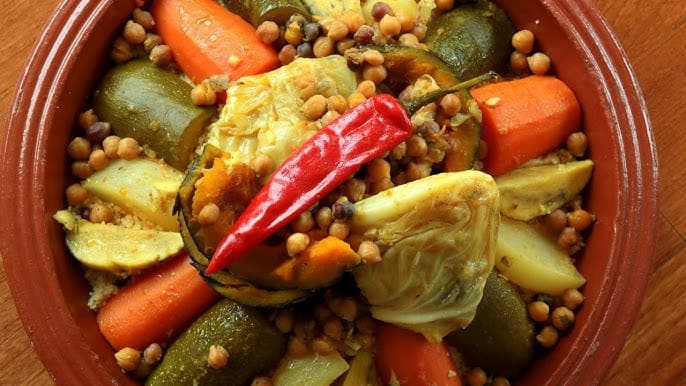
The broth below is where regional identity asserts itself. In Fez, the broth tends toward sweetness, with caramelized onions and raisins. In Marrakech, the seven-vegetable couscous dominates, a towering construction of turnips, carrots, zucchini, cabbage, tomatoes, pumpkin, and chickpeas that is as much architectural statement as it is dinner. Along the coast, fish couscous appears, the broth fragrant with chermoula and the sea. In the mountains, barley couscous replaces the semolina, heartier and more rustic, suited to cold nights at altitude.
But the constants across all regions reveal what matters most. The meal is always shared from a single platter. Diners eat with their hands, or more precisely, with the fingers of the right hand, working the couscous into small balls with a deft rolling motion. The communal plate is not an accident of economy but a deliberate expression of togetherness. To serve couscous on individual plates would strike most Moroccan families as missing the entire point.

Roden has noted that the spatial arrangement around the platter follows unspoken rules. The choicest cuts of meat are placed in the center, visible to all. The vegetables form concentric rings. Elder family members are served first, and it is customary for the host to push particularly good pieces toward honored guests, a gesture of generosity performed without words.
The lamb that tops the Friday couscous deserves particular attention. In most Moroccan households, the meat is cooked low and slow in the broth itself, absorbing the spices and contributing its own richness back to the liquid. The spicing is characteristically Moroccan: a base of onion and garlic, saffron for color and its particular honeyed bitterness, ginger for warmth, turmeric for earthiness, and ras el hanout for complexity. The meat, by the time it reaches the platter, should be tender enough to pull apart with fingers, its fibers having surrendered their toughness to hours of gentle simmering.
What makes the Friday couscous tradition remarkable in the modern era is its persistence. Morocco has urbanized rapidly. Young Moroccans live in apartments, commute to offices, eat at fast food chains that would be unrecognizable to their grandparents. And yet the Friday meal endures. Crawford has observed that even in diaspora communities across Europe, the Friday couscous remains a gravitational center for Moroccan families, adapted to new circumstances but structurally intact. The platter may be smaller, the vegetables sourced from a Parisian supermarket rather than a village garden, but the gathering happens.
There is a sociological explanation for this resilience, and it has to do with the meal's function as connective tissue. Friday couscous is the weekly moment when extended families reconvene. It is where news is exchanged, conflicts are negotiated, marriages are discussed, and children absorb the rhythms of their culture simply by being present. To lose the Friday meal would be to lose a primary mechanism of social cohesion.
The culinary world outside Morocco has begun to take couscous more seriously, though understanding remains uneven. In most Western kitchens, couscous is treated as a quick side dish, boiled and fluffed in five minutes. The result bears roughly the same relationship to real Moroccan couscous as a microwave dinner bears to a holiday feast. The boxed product is pre-steamed and dried, designed for convenience. It will sustain life. It will not change it.
For those who wish to bridge that gap, the entry point is the technique rather than the recipe. Learning to steam couscous properly, to feel the grain between the fingers, to judge when it has absorbed enough moisture and heat, is worth more than any list of ingredients. The vegetables and meats can vary infinitely. The broth can be adapted to whatever is fresh and available. But the grain itself, prepared with attention and patience, is what makes the difference between a meal and a ritual.
The Friday couscous, in the end, is less about food than it is about time. It takes time to prepare. It takes time to eat. It takes time to sit with family afterward, drinking mint tea and letting the afternoon unfold without urgency. In a world that has organized itself around speed and efficiency, the Moroccan Friday meal remains a weekly argument for slowness, for gathering, for the radical act of sitting down together and sharing from a single plate.
— More to read

— 10 Minute · Article
Ramadan at the Table: The Foods That Break the Fast
When the sun sets during the holy month, the first bite is never random. Across the Muslim world, iftar follows a structure as precise as the fast itself, shaped by centuries of nutritional wisdom, religious practice, and culinary tradition.

— 10 Minute · Article
Liquid Gold: What Most People Get Wrong About Olive Oil
The bottle in your pantry is almost certainly not what it claims to be. The olive oil industry is plagued by fraud, misunderstanding, and a chemical complexity that most consumers never encounter. Here is what actually matters.

— 11 Minute · Article
The Tagine: A Vessel Shaped by Centuries
Long before Dutch ovens or pressure cookers, Berber cooks in North Africa perfected a conical clay vessel that turns scarce water and low heat into extraordinary depth of flavor — and modern food science is only now explaining why.

— 12 Minute · Article
Preserved Lemons — The Science, the Tradition, and the Three Weeks That Change Everything
Salt, citrus, time. Inside the Moroccan pantry staple that food scientists and chefs across three continents consider irreplaceable.

— 14 Minute · Article
The Lobster Chapter — From Trap to Table on the New England Coast
How a cold-water crustacean became the centerpiece of New England identity — and what most people still get wrong about cooking it.

— 9 Minute · Article
The Private Chef Question: What Happens When Dinner Is the Event
Private dining is booming. But the shift from restaurant kitchen to someone's home changes everything — the menu, the service, the relationship between chef and guest. Inside the quiet rise of dinner as experience.

— 9 Minute · Article
French Technique, Moroccan Soul: Where Two Traditions Meet
Confit and m'chermel. Roux and smen. Braise and tagine. The culinary overlap between France and Morocco runs deeper than colonial history — it is a conversation between two of the world's great kitchen traditions.

— 9 Minute · Article
The Table Is the Thing: Why Setting Matters as Much as Cooking
A perfectly cooked dish served on the wrong plate, in the wrong light, at the wrong height, loses something essential. The art of table setting is not decoration — it is the final act of cooking.

— 9 Minute · Article
Sourcing in New England: A Chef's Guide to the Local Supply Chain
Between the Boston Fish Pier and the winter CSA box, New England's food supply chain is more complex — and more fragile — than most diners realize. A practical look at what local actually means.

— 8 Minute · Article
The Grandmother Test: When a Recipe Is Actually Done
She never set a timer. She listened to the tagine, pressed the dough, smelled the bread. The unwritten knowledge of grandmothers is the most valuable — and most endangered — form of culinary intelligence.