
April 8, 2026

— 11 Minute · April 8, 2026
The Tagine: A Vessel Shaped by Centuries
Long before Dutch ovens or pressure cookers, Berber cooks in North Africa perfected a conical clay vessel that turns scarce water and low heat into extraordinary depth of flavor — and modern food science is only now explaining why.
In the medinas of Marrakech, Fez, and Meknes, the tagine is as commonplace as a saucepan. Stacked in pyramids at pottery stalls, glazed in burnt orange and olive green, the conical clay vessels are simultaneously cookware, serving dish, and cultural artifact. But the tagine is far more than a souvenir for tourists. It is a piece of culinary technology refined over centuries in one of the world's harshest cooking environments — a vessel designed to coax maximum flavor from minimal water, built for the realities of arid North African life long before anyone had a word for thermodynamics.
The origins of the tagine are difficult to pin to a single date or place, but most food historians trace it to the indigenous Berber (Amazigh) peoples of the Maghreb. Paula Wolfert, the James Beard Award-winning author whose book "Couscous and Other Good Food from Morocco" introduced Moroccan cuisine to American kitchens in 1973, spent decades researching the vessel's history. She documented tagine use among rural Berber communities in the Atlas Mountains where cooking methods had remained largely unchanged for generations. In these communities, the tagine was not merely preferred — it was essential. Firewood was scarce, water scarcer, and the conical lid's ability to recirculate steam meant that tough cuts of mutton or goat could be braised to tenderness with remarkably little liquid and almost no fuel beyond a low charcoal fire.
The physics of why the tagine works so well is a question that fascinated Harold McGee, the chemist and author of "On Food and Cooking," a book that remains the definitive reference on kitchen science more than four decades after its first publication. McGee explained that the tall conical lid creates a significant temperature gradient between its base (hot, near the food) and its apex (cooler, exposed to ambient air). Steam rises from the simmering liquid, hits the cooler interior walls of the cone, condenses back into water droplets, and drips back down onto the food. This continuous cycle of evaporation and condensation is, in effect, a self-basting system. The food is never exposed to dry heat, never loses its moisture to the open air, and the flavors concentrate slowly as the braise progresses.
McGee also noted a subtler benefit: the clay itself. Unglazed earthenware is porous, which means it absorbs and releases moisture gradually. A well-seasoned tagine — one that has been used hundreds of times — develops a patina of absorbed fats and cooking liquids that contributes to the flavor of every subsequent dish. This is analogous to the seasoning of a cast-iron skillet, but the mechanism is different. Cast iron polymerizes oil on its surface; clay absorbs it into its structure. The result is a cooking vessel that literally carries the memory of past meals.
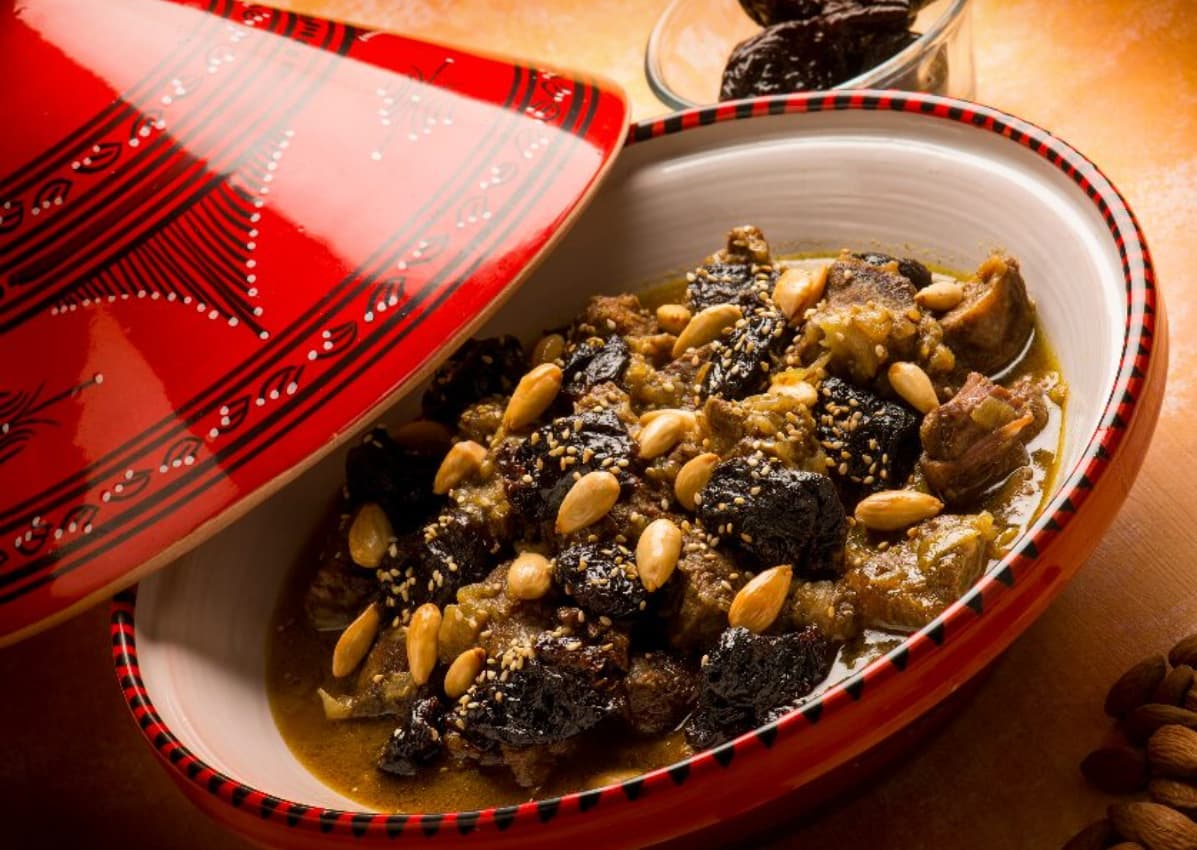
The regional variations of the tagine across Morocco reflect both geography and culture. In the north, near the Mediterranean coast, tagines tend to be lighter, often featuring fish, olives, and preserved lemons — ingredients that reflect centuries of trade with Spain and the broader Mediterranean world. In the interior, around Fez and Meknes, lamb and beef tagines dominate, enriched with prunes, almonds, and the complex spice mixture known as ras el hanout. In the south, toward the Sahara, tagines become sparser, relying on root vegetables, dried legumes, and whatever protein is available. Wolfert documented these regional distinctions meticulously, noting that the tagine is not a single dish but a method — a way of slow-braising that adapts to whatever ingredients the land provides.

Mourad Lahlou, the Marrakech-born chef behind the celebrated San Francisco restaurant Mourad, has spent his career translating these traditions for American diners. Lahlou, who earned a Michelin star for his modern Moroccan cuisine, has spoken extensively about the tagine as a philosophical statement about cooking. In his view, the vessel embodies a principle that Western kitchens often neglect: patience. A tagine cannot be rushed. It operates at a simmer, never a boil. The flavors develop over hours, not minutes. The collagen in a lamb shank breaks down slowly into gelatin, the onions caramelize at the bottom of the pot, the spices bloom and meld in the gentle, moist heat. The result is a dish of extraordinary depth — silky, complex, aromatic — achieved without any of the high-heat techniques (searing, deglazing, reducing) that define French braising.
This distinction matters more than it might seem. French braising, the classical technique taught in culinary schools worldwide, typically begins with a hard sear to develop a Maillard crust, followed by deglazing with wine or stock, then slow cooking in a covered vessel. The tagine method skips the sear entirely. Meat goes into the pot raw, layered with onions, spices, and a small amount of liquid. The result is a fundamentally different texture and flavor profile — less caramelized, more aromatic, with a silkiness that comes from the unbroken emulsion of rendered fat and cooking liquid.
The clay vessel itself deserves careful handling. A new tagine must be soaked in water for several hours before its first use, to saturate the porous clay and prevent it from cracking over heat. It should never be placed over high flame or subjected to sudden temperature changes. The base should always be started over low heat and brought up gradually. Many Moroccan cooks place a metal diffuser between the tagine and the flame, distributing heat evenly across the bottom and preventing hot spots that can scorch food or crack clay.

For all its elegance, the tagine is not a museum piece. It is working technology, used daily in millions of Moroccan households. In the souks, public bread ovens double as communal tagine stations, where families bring their assembled pots to cook slowly in the residual heat of the oven. Street vendors serve tagines bubbling on portable charcoal braziers. And in modern Moroccan kitchens, the tagine coexists comfortably with pressure cookers and gas ranges — not as a relic, but as the preferred tool for specific dishes that no other vessel produces quite as well.
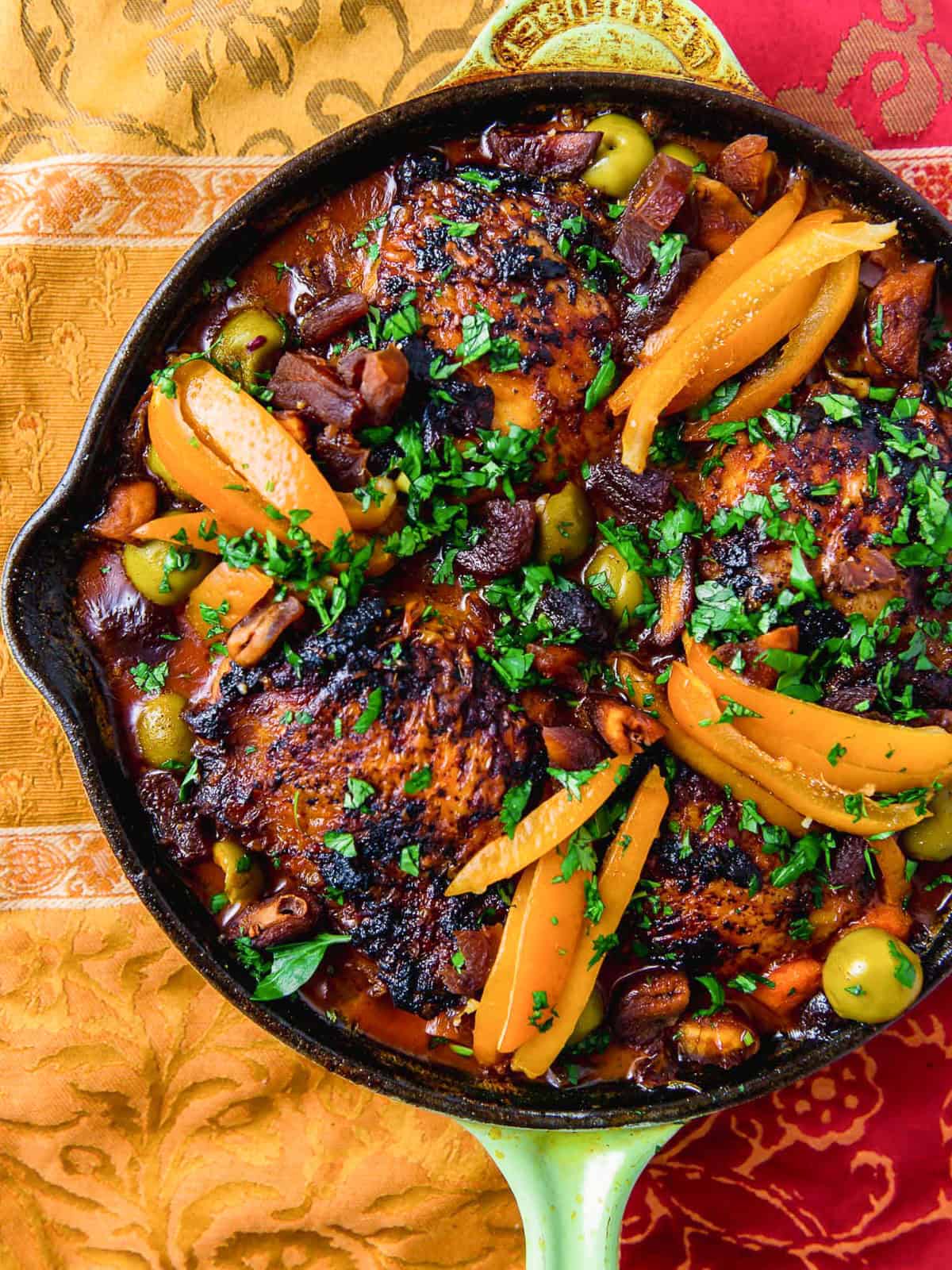
The Western kitchen has, in recent years, discovered the tagine with the same enthusiasm it once brought to the wok, the tandoor, and the plancha. Le Creuset and Emile Henry now produce enameled cast-iron and ceramic versions designed for modern stovetops and ovens. These function well as braising vessels, but they lack the porosity and thermal behavior of traditional Moroccan clay. The food they produce is good, but subtly different — more akin to a Dutch-oven braise than a true tagine.
For cooks willing to invest in an authentic clay tagine and learn its rhythms, the rewards are considerable. The vessel teaches a form of cooking that is increasingly rare in the age of the Instant Pot: slow, attentive, governed by feel rather than timers. The conical lid lifts to reveal a dish that is simultaneously simple and layered, humble and luxurious. It is a reminder that the most sophisticated culinary technology is not always the newest — and that a clay pot shaped by Berber hands a thousand years ago still has something to teach the modern kitchen.
The marrakchi beef tanjia, a related but distinct tradition, uses a different vessel — an amphora-shaped clay urn sealed with parchment and cooked in the embers of a public bathhouse furnace. It is the tagine's wilder cousin, a bachelor's dish by reputation, and a reminder that Moroccan clay-pot cooking is not monolithic but a family of techniques, each shaped by local ingredients, local customs, and the particular genius of cooks working within constraints.
— More to read

— 10 Minute · Article
Ramadan at the Table: The Foods That Break the Fast
When the sun sets during the holy month, the first bite is never random. Across the Muslim world, iftar follows a structure as precise as the fast itself, shaped by centuries of nutritional wisdom, religious practice, and culinary tradition.

— 10 Minute · Article
Liquid Gold: What Most People Get Wrong About Olive Oil
The bottle in your pantry is almost certainly not what it claims to be. The olive oil industry is plagued by fraud, misunderstanding, and a chemical complexity that most consumers never encounter. Here is what actually matters.

— 12 Minute · Article
Preserved Lemons — The Science, the Tradition, and the Three Weeks That Change Everything
Salt, citrus, time. Inside the Moroccan pantry staple that food scientists and chefs across three continents consider irreplaceable.

— 14 Minute · Article
The Lobster Chapter — From Trap to Table on the New England Coast
How a cold-water crustacean became the centerpiece of New England identity — and what most people still get wrong about cooking it.

— 9 Minute · Article
The Private Chef Question: What Happens When Dinner Is the Event
Private dining is booming. But the shift from restaurant kitchen to someone's home changes everything — the menu, the service, the relationship between chef and guest. Inside the quiet rise of dinner as experience.

— 9 Minute · Article
French Technique, Moroccan Soul: Where Two Traditions Meet
Confit and m'chermel. Roux and smen. Braise and tagine. The culinary overlap between France and Morocco runs deeper than colonial history — it is a conversation between two of the world's great kitchen traditions.

— 9 Minute · Article
The Table Is the Thing: Why Setting Matters as Much as Cooking
A perfectly cooked dish served on the wrong plate, in the wrong light, at the wrong height, loses something essential. The art of table setting is not decoration — it is the final act of cooking.

— 9 Minute · Article
Sourcing in New England: A Chef's Guide to the Local Supply Chain
Between the Boston Fish Pier and the winter CSA box, New England's food supply chain is more complex — and more fragile — than most diners realize. A practical look at what local actually means.

— 8 Minute · Article
The Grandmother Test: When a Recipe Is Actually Done
She never set a timer. She listened to the tagine, pressed the dough, smelled the bread. The unwritten knowledge of grandmothers is the most valuable — and most endangered — form of culinary intelligence.

— 9 Minute · Article
On Bread: The Oldest Recipe in the World
From Moroccan khobz baked in communal ovens to the exacting crumb of a French baguette, bread remains the one recipe every civilization shares. A look at the science, history, and quiet revolution happening in flour and water.