
May 20, 2026

— 10 Minute · May 20, 2026
Ramadan at the Table: The Foods That Break the Fast
When the sun sets during the holy month, the first bite is never random. Across the Muslim world, iftar follows a structure as precise as the fast itself, shaped by centuries of nutritional wisdom, religious practice, and culinary tradition.
The cannon fires. In cities across the Muslim world, from Casablanca to Cairo to Istanbul, the signal comes at sunset: a cannon blast, a siren, the amplified voice of the muezzin, or simply the moment when the sky darkens enough that a white thread can no longer be distinguished from a black one, the ancient Quranic criterion for nightfall. After fourteen or more hours without food or water, the fast of Ramadan is broken. And the first thing that reaches the lips is almost always a date.
The date is not arbitrary. The Prophet Muhammad is reported to have broken his fast with dates and water, and this sunnah, this prophetic practice, has shaped iftar tables for fourteen centuries. But there is also a physiological logic that modern science has begun to articulate. Dr. Satchidananda Panda, a professor at the Salk Institute for Biological Studies and one of the leading researchers on circadian biology and time-restricted eating, has noted that dates provide a rapid source of natural sugars, primarily glucose and fructose, that restore blood glucose levels without the sharp insulin spike that processed sugars would provoke. The fiber content slows absorption enough to prevent a crash. It is, in biochemical terms, a remarkably intelligent way to restart a digestive system that has been dormant since dawn.

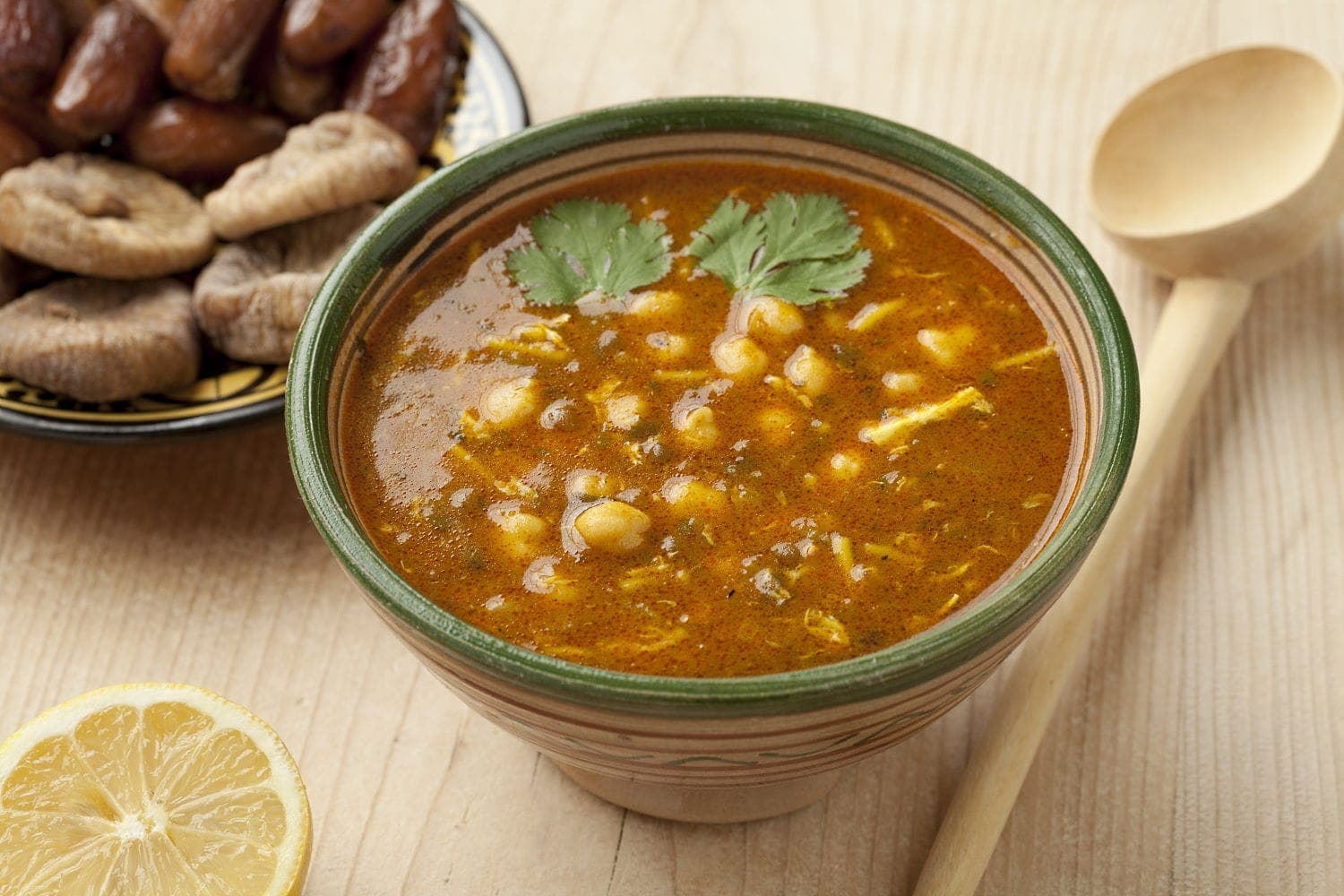
After the dates comes the soup. In Morocco, this means harira, and the word carries a weight that no translation quite captures. Harira is not merely a soup; it is the taste of Ramadan itself, as inseparable from the holy month as the prayers and the predawn meal. The base is tomato, enriched with chickpeas or lentils or both, thickened slightly with flour or a slurry of fermented dough called tedouira, and finished with a generous handful of fresh cilantro, parsley, and a squeeze of lemon. The spicing is warm but not aggressive: ginger, turmeric, cinnamon, black pepper. The texture falls somewhere between a soup and a stew, substantial enough to begin the work of nourishing a fasted body without overwhelming a stomach that has been empty all day.
Anissa Helou, the Beirut-born food writer whose book Feast: Food of the Islamic World remains the most comprehensive English-language survey of cooking across Muslim cultures, has traced the harira tradition to medieval Morocco, noting that regional variations exist across North Africa and into the Iberian Peninsula, wherever Moroccan culinary influence traveled. In Fez, the harira tends to be richer, with more meat and a deeper spice profile. In the countryside, it is simpler, sometimes little more than lentils, tomatoes, and herbs. But the structure is constant: a warm, liquid, nourishing first course that prepares the stomach for what follows.
What follows is the iftar proper, and its abundance can be staggering. Claudia Roden has written extensively about the paradox of Ramadan: a month of deprivation that produces some of the most extravagant cooking of the year. The explanation lies in the social function of iftar. Breaking the fast is a communal act, and the table is expected to reflect both generosity and gratitude. To set a spare table during Ramadan, even if one's means are modest, would feel like a failure of hospitality.

In Moroccan households, the iftar spread typically includes hard-boiled eggs, often nestled into the harira or served alongside it. There are small savory pastries, particularly briouats, triangular parcels of thin warqa dough filled with seasoned ground meat, cheese, or seafood and fried until golden. There are dates stuffed with almond paste. There is fresh bread, often beghrir, the spongy semolina pancakes with their distinctive thousand-hole surface, served with butter and honey. And there is msemen, the layered flatbread that is torn by hand and used to scoop up everything else.
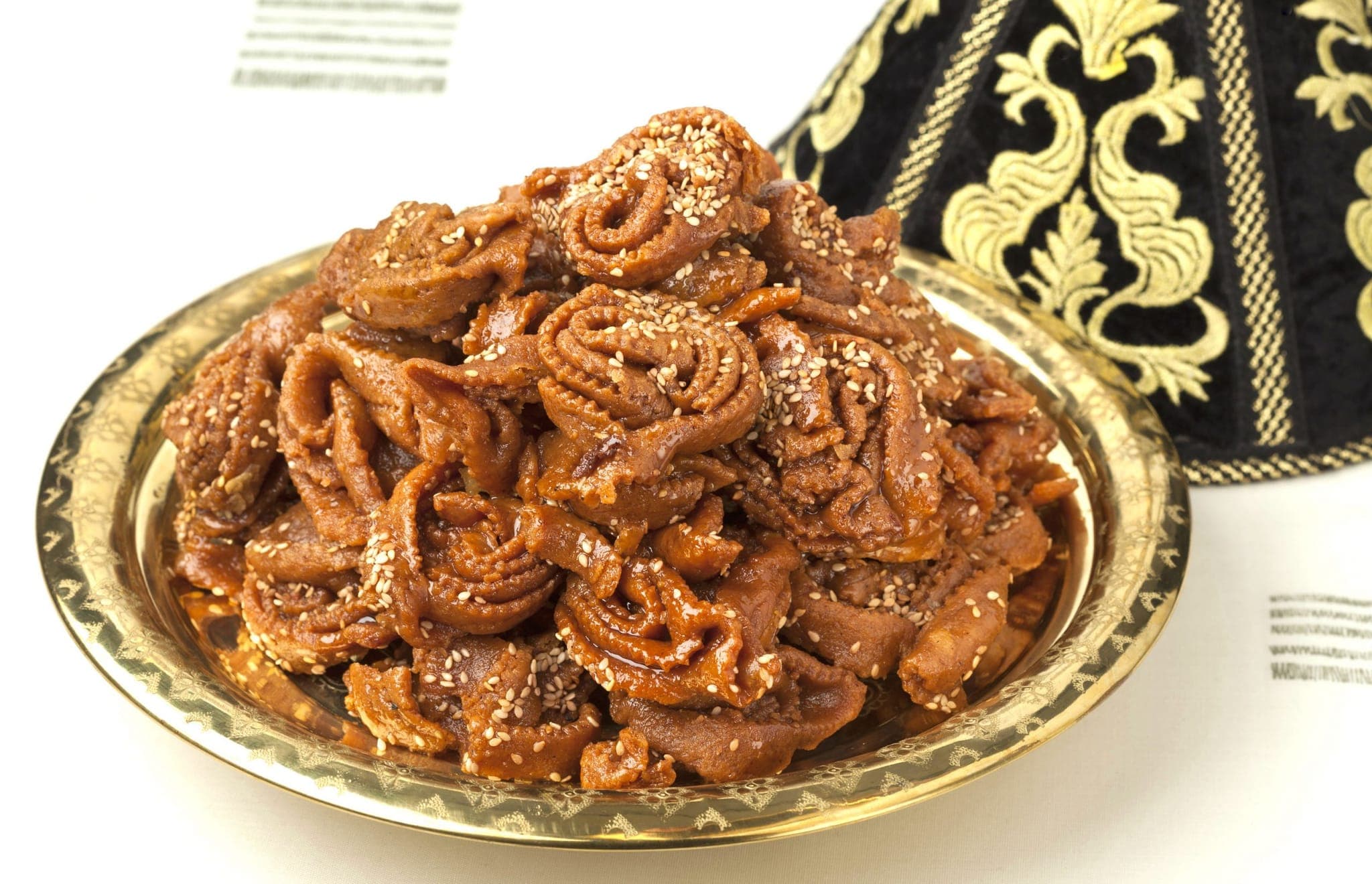
The sweet course occupies a position of particular importance during Ramadan, and in Morocco, it is dominated by two preparations: chebakia and sellou. Chebakia are flower-shaped pastries of remarkable complexity. The dough incorporates sesame seeds, anise, saffron, and sometimes ground almonds. It is rolled thin, cut into strips, folded into rosette shapes with practiced dexterity, deep-fried, and immediately plunged into hot honey scented with orange blossom water. The finished pastry is crisp, sticky, fragrant, and extraordinarily sweet, designed to deliver rapid energy to a fasted body while also serving as a vehicle for the honey that Moroccan tradition considers particularly blessed during Ramadan.
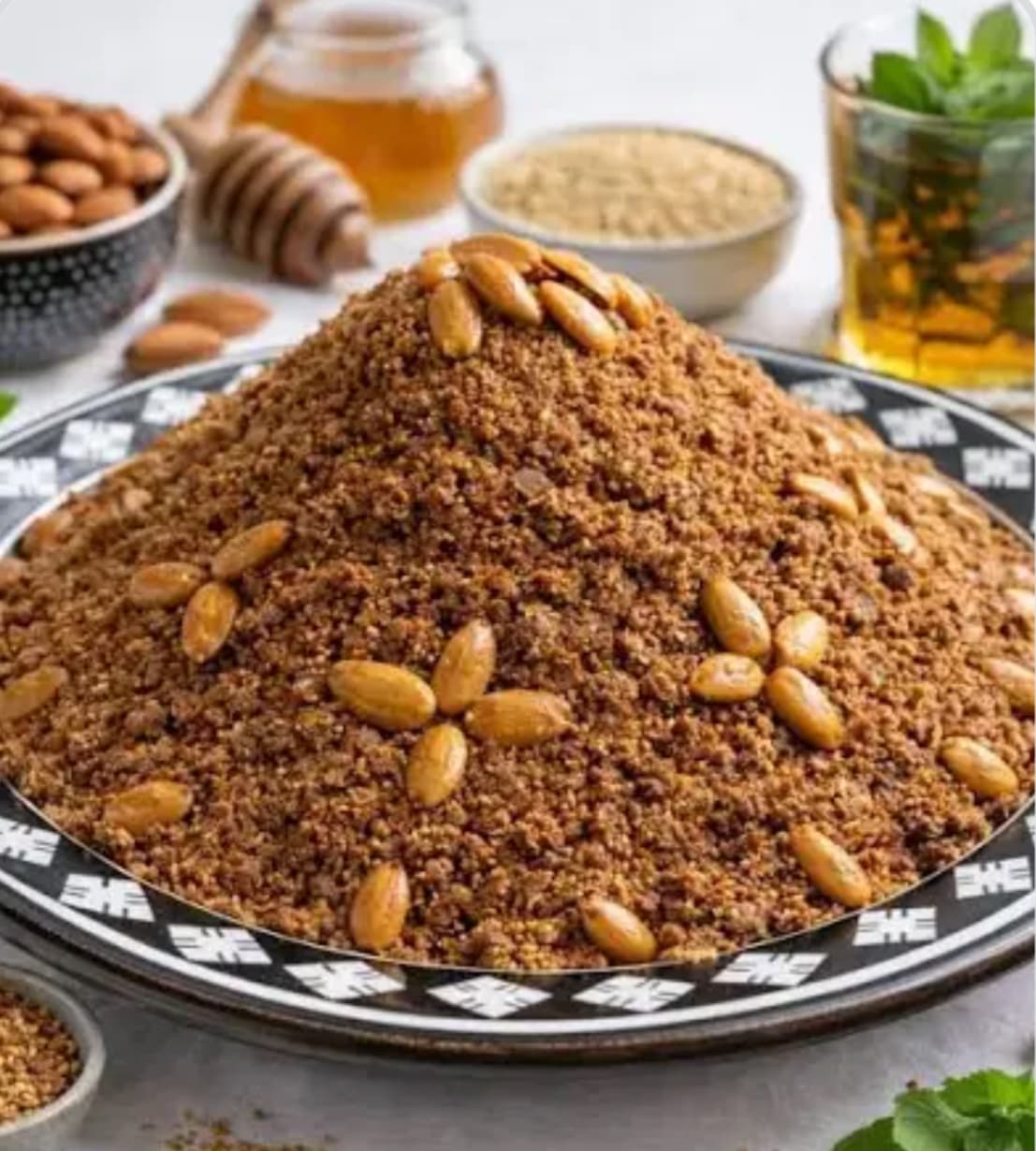
Sellou, sometimes called sfouf or zemita depending on the region, is even more calorie-dense: a crumbly, confection-like mixture of toasted flour, ground almonds, sesame seeds, butter, honey, and warm spices. It requires no cooking after assembly and keeps well, making it practical for a month of altered schedules and communal drop-ins. Its texture is unique, somewhere between a powder and a paste, and it is typically eaten in small amounts, scooped with a spoon or pressed into balls.

The nutritional science of these Ramadan foods reveals patterns that align with what modern research has confirmed about refeeding after extended fasts. Panda's work on circadian eating patterns has demonstrated that the timing and composition of the first meal after a fast significantly affects metabolic response. Foods that combine simple sugars with fats, fiber, and protein, precisely the combination found in a traditional iftar, produce a more measured glycemic response than simple carbohydrates alone. The traditional Moroccan iftar, with its dates, soup, eggs, pastries, and bread, delivers a sequence of nutrients that moves from quickly absorbed sugars to more complex combinations, essentially staging the refeeding process rather than flooding the system all at once.
This is not to suggest that medieval Moroccan cooks were conducting glycemic index research. But there is a pattern, observable across many traditional food cultures, where practices that evolved through centuries of collective experience arrive at solutions that modern science later validates. The structure of iftar, dates first, soup second, heavier foods third, mirrors contemporary nutritional advice for breaking extended fasts almost exactly.
Beyond Morocco, the iftar table varies enormously across the Muslim world, but certain principles hold. In Egypt, the breaking of the fast often centers on ful medames, the slow-cooked fava bean stew that serves as the country's national dish, alongside apricot juice, or qamar al-din, made from dried apricot sheets dissolved in water. In Turkey, pide bread, a Ramadan-specific flatbread studded with sesame and nigella seeds, appears only during the holy month. In South Asia, the iftar spread might include pakoras, fruit chaat, and haleem, a rich stew of wheat, lentils, and meat slow-cooked to a silky porridge.
Helou has documented how these regional variations, despite their surface differences, share a deep structural similarity. They all begin with hydration and simple sugars. They all move toward complex carbohydrates and proteins. They all incorporate some element of celebration and generosity. The specific ingredients are shaped by local agriculture and culinary tradition, but the underlying logic is universal.
The social dimension of Ramadan eating deserves equal attention. Iftar is rarely a private affair. Mosques set up communal tables where anyone can eat. Neighbors send plates to one another. Wealthy families sponsor public iftar meals for those in need. The act of feeding others during Ramadan carries particular religious significance, and the result is a month-long exercise in communal eating that strengthens social bonds in tangible ways.
The predawn meal, suhoor, receives less attention but plays its own crucial role. Eaten before the fajr prayer, it is typically simpler and heavier, designed to sustain the body through the long daylight hours ahead. In Morocco, this often means leftover harira, bread with olive oil and honey, eggs, and strong mint tea. The advice across most traditions is consistent: eat protein and complex carbohydrates, drink plenty of water, and avoid foods that will provoke thirst.
Ramadan's culinary traditions are, at their core, a sustained meditation on the relationship between deprivation and gratitude. The fast strips eating down to its essentials, reminding the practitioner that food is not a given but a gift. The iftar rebuilds, offering not just nourishment but community, not just calories but meaning. The foods themselves, the dates and the harira and the honey-drenched pastries, are the material through which this spiritual practice becomes tangible, felt in the body as much as in the soul.
— More to read

— 10 Minute · Article
Liquid Gold: What Most People Get Wrong About Olive Oil
The bottle in your pantry is almost certainly not what it claims to be. The olive oil industry is plagued by fraud, misunderstanding, and a chemical complexity that most consumers never encounter. Here is what actually matters.

— 11 Minute · Article
The Tagine: A Vessel Shaped by Centuries
Long before Dutch ovens or pressure cookers, Berber cooks in North Africa perfected a conical clay vessel that turns scarce water and low heat into extraordinary depth of flavor — and modern food science is only now explaining why.

— 12 Minute · Article
Preserved Lemons — The Science, the Tradition, and the Three Weeks That Change Everything
Salt, citrus, time. Inside the Moroccan pantry staple that food scientists and chefs across three continents consider irreplaceable.

— 14 Minute · Article
The Lobster Chapter — From Trap to Table on the New England Coast
How a cold-water crustacean became the centerpiece of New England identity — and what most people still get wrong about cooking it.

— 9 Minute · Article
The Private Chef Question: What Happens When Dinner Is the Event
Private dining is booming. But the shift from restaurant kitchen to someone's home changes everything — the menu, the service, the relationship between chef and guest. Inside the quiet rise of dinner as experience.

— 9 Minute · Article
French Technique, Moroccan Soul: Where Two Traditions Meet
Confit and m'chermel. Roux and smen. Braise and tagine. The culinary overlap between France and Morocco runs deeper than colonial history — it is a conversation between two of the world's great kitchen traditions.

— 9 Minute · Article
The Table Is the Thing: Why Setting Matters as Much as Cooking
A perfectly cooked dish served on the wrong plate, in the wrong light, at the wrong height, loses something essential. The art of table setting is not decoration — it is the final act of cooking.

— 9 Minute · Article
Sourcing in New England: A Chef's Guide to the Local Supply Chain
Between the Boston Fish Pier and the winter CSA box, New England's food supply chain is more complex — and more fragile — than most diners realize. A practical look at what local actually means.

— 8 Minute · Article
The Grandmother Test: When a Recipe Is Actually Done
She never set a timer. She listened to the tagine, pressed the dough, smelled the bread. The unwritten knowledge of grandmothers is the most valuable — and most endangered — form of culinary intelligence.

— 9 Minute · Article
On Bread: The Oldest Recipe in the World
From Moroccan khobz baked in communal ovens to the exacting crumb of a French baguette, bread remains the one recipe every civilization shares. A look at the science, history, and quiet revolution happening in flour and water.