
April 15, 2026

— 11 Minute · April 15, 2026
Saffron: The Thread That Connects Three Continents
Harvested by hand from a flower that blooms for two weeks each autumn, saffron is the world's most expensive spice by weight — a slender crimson thread whose story spans Persian empires, Moroccan hillsides, and the risotto pots of Milan.
It takes roughly 75,000 crocus flowers to produce a single pound of saffron. Each Crocus sativus bloom yields exactly three stigmas — the slender, deep-crimson threads that, once dried, become the spice that has commanded extraordinary prices for millennia. At current market rates, high-quality saffron sells for $5,000 to $10,000 per kilogram, placing it in the same economic territory as certain precious metals. No machine has ever successfully replicated the delicate work of human hands plucking those threads from the flower at dawn, before the morning sun damages the volatile compounds that give saffron its color, flavor, and aroma.
The botany of Crocus sativus is itself remarkable. The plant is a sterile triploid — it cannot reproduce from seed. Every saffron crocus in every field on Earth descends from corms (bulb-like structures) that must be manually divided and replanted. This means the species is entirely dependent on human cultivation, a relationship that Dr. Hossein Bagheri, a plant biochemist at Ferdowsi University of Mashhad who has spent decades researching saffron genetics, describes as one of the oldest and most intimate partnerships between a plant and a civilization. Bagheri's research into the genetic diversity of saffron cultivars suggests that the plant was first domesticated in the region of modern-day Iran, possibly in the Bronze Age, and spread westward along trade routes to the Mediterranean, North Africa, and eventually Spain.

Iran remains the dominant producer, accounting for roughly 90 percent of the world's saffron supply. The Khorasan province, with its cold winters, hot summers, and well-drained soils, provides ideal growing conditions. But Iran's dominance in volume has not always corresponded to dominance in reputation. Spanish saffron, particularly the La Mancha denomination, has historically commanded premium prices in European markets, despite producing only a fraction of Iran's output. And in recent decades, Moroccan saffron from the Taliouine region — a small area in the Anti-Atlas Mountains — has emerged as a contender for the finest in the world.
The Taliouine saffron harvest, which takes place each November, is a communal event. Entire families rise before dawn to pick the flowers, which must be gathered in the brief window between the bud opening and the sun's heat degrading the stigmas. The threads are then dried over low heat — traditionally over charcoal, though modern producers use temperature-controlled dehydrators. Pat Willard, whose book "Secrets of Saffron" is the most comprehensive English-language history of the spice, documented the Taliouine harvest and its economic significance. For many families in this remote mountain region, saffron is the primary cash crop, and the difference between a good harvest and a bad one can determine a year's income.
What makes saffron worth its extraordinary price is not simply scarcity but chemistry. The three key compounds responsible for saffron's sensory profile are crocin (which provides the vivid golden-yellow color), picrocrocin (which gives the distinctive bittersweet taste), and safranal (which produces the complex, hay-like aroma). Dr. Bagheri's research has shown that the concentration of these compounds varies significantly depending on growing conditions, harvest timing, and drying method. Saffron picked too late in the day, or dried too quickly at high temperatures, loses substantial safranal content, resulting in threads that color food effectively but lack the depth of flavor and aroma that distinguishes great saffron from merely good saffron.
Adulteration is the dark shadow that has followed saffron throughout its history. The spice's extreme value-to-weight ratio makes it an irresistible target for fraud. In medieval Europe, selling adulterated saffron was punishable by death in some jurisdictions — the Nuremberg Safranschou laws of the fifteenth century prescribed burial alive or burning at the stake. Modern adulterants are less dramatically punished but no less prevalent. Common tricks include adding weight with oil or honey, mixing in safflower petals or marigold stamens, or dyeing lower-grade threads with artificial colorants. Willard noted in her research that an estimated 50 to 70 percent of saffron sold at retail worldwide may be adulterated to some degree — a staggering figure that underscores the importance of sourcing from reputable suppliers.

For the cook, the practical question is how to use saffron effectively. Claudia Roden, the Egyptian-born British food writer whose work on Middle Eastern and Mediterranean cuisines spans six decades and multiple James Beard Awards, has written extensively about saffron's role in the dishes of the cultures she documents. Roden emphasizes that saffron must be bloomed — steeped in warm liquid before being added to a dish — to release its full color and flavor. Dropping dry threads directly into a pot is wasteful, as the compounds need time and moisture to dissolve. A pinch of threads steeped in a few tablespoons of hot water or broth for fifteen to twenty minutes will yield a vivid, aromatic liquid that distributes evenly through a dish.
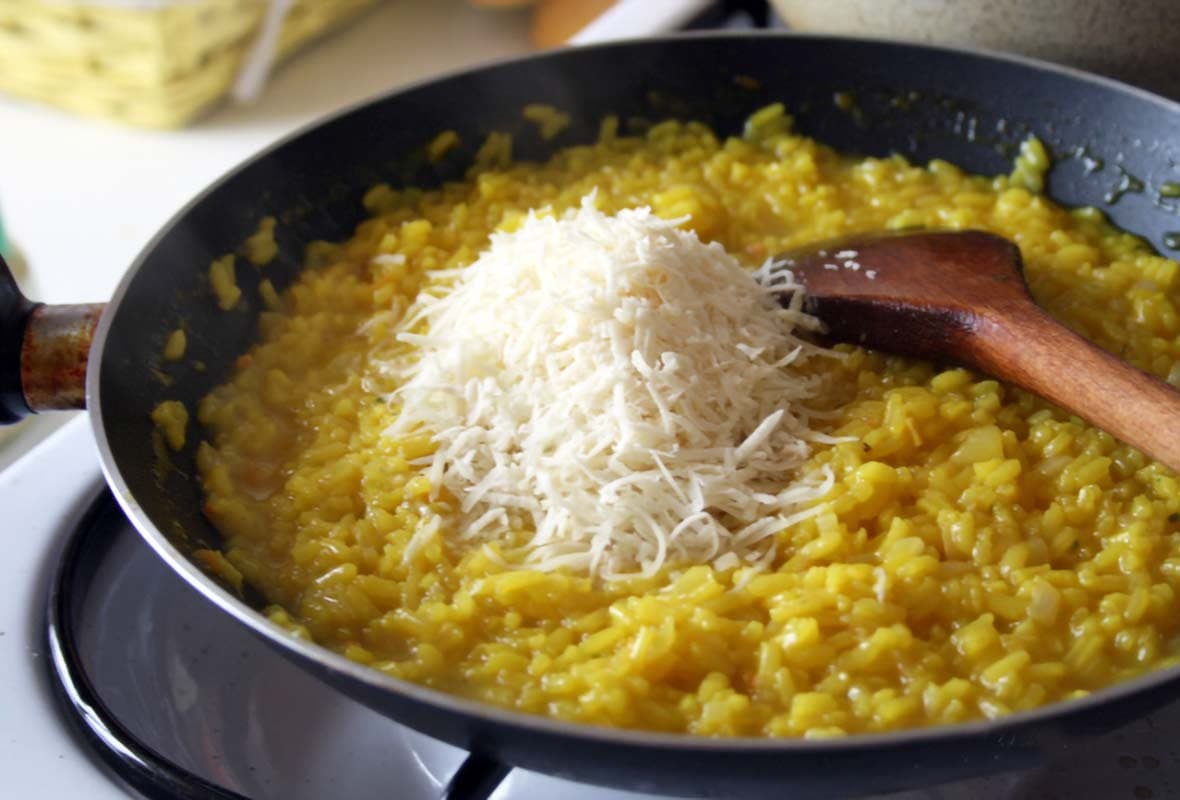
The culinary applications of saffron reveal as much about culture as about flavor. In Iran, saffron infuses rice, stews, and the prized tahdig — the crispy golden crust at the bottom of a rice pot. In Morocco, it is essential to tagines, to the layered pastry bastilla, and to the spice mixture ras el hanout. In Spain, it defines paella. And in northern Italy, saffron is the soul of risotto alla milanese, the golden rice dish that has been a Lombard tradition since at least the sixteenth century. The legend holds that a stained-glass worker at the Duomo di Milano, accustomed to using saffron as a pigment, joked that he would one day put it in his master's risotto. The joke became tradition, and the tradition became canon.
What unites these diverse applications is a shared understanding that saffron is not merely a colorant but a flavor — subtle, complex, and unlike anything else in the spice cabinet. It is floral without being perfumed, bitter without being harsh, earthy without being heavy. In sufficient quantity, it imparts a faintly metallic, honey-like sweetness that is difficult to describe and impossible to replicate with substitutes. Turmeric, the most common stand-in, provides color but none of saffron's aromatic complexity.

The economics of saffron are shifting. Climate change is altering growing conditions in traditional producing regions. In Iran, water scarcity is an escalating threat to Khorasan's dominance. Meanwhile, new producers in Afghanistan, India (Kashmir), and even Vermont have entered the market, drawn by the crop's high per-acre value. Whether these new sources will maintain the quality standards established by centuries of Persian, Moroccan, and Spanish cultivation remains an open question.
For the home cook, the best advice is simple: buy saffron in thread form from a trusted source, store it in an airtight container away from light, and use it with intention. A gram of good saffron — roughly a heaping teaspoon of threads — costs less than a glass of decent wine and will flavor four to six dishes. Bloom it, add it early in the cooking process, and let its chemistry do the work. The thread that connects three continents asks only for patience and a little warm water to reveal itself.
— More to read

— 10 Minute · Article
Ramadan at the Table: The Foods That Break the Fast
When the sun sets during the holy month, the first bite is never random. Across the Muslim world, iftar follows a structure as precise as the fast itself, shaped by centuries of nutritional wisdom, religious practice, and culinary tradition.

— 10 Minute · Article
Liquid Gold: What Most People Get Wrong About Olive Oil
The bottle in your pantry is almost certainly not what it claims to be. The olive oil industry is plagued by fraud, misunderstanding, and a chemical complexity that most consumers never encounter. Here is what actually matters.

— 11 Minute · Article
The Tagine: A Vessel Shaped by Centuries
Long before Dutch ovens or pressure cookers, Berber cooks in North Africa perfected a conical clay vessel that turns scarce water and low heat into extraordinary depth of flavor — and modern food science is only now explaining why.

— 12 Minute · Article
Preserved Lemons — The Science, the Tradition, and the Three Weeks That Change Everything
Salt, citrus, time. Inside the Moroccan pantry staple that food scientists and chefs across three continents consider irreplaceable.

— 14 Minute · Article
The Lobster Chapter — From Trap to Table on the New England Coast
How a cold-water crustacean became the centerpiece of New England identity — and what most people still get wrong about cooking it.

— 9 Minute · Article
The Private Chef Question: What Happens When Dinner Is the Event
Private dining is booming. But the shift from restaurant kitchen to someone's home changes everything — the menu, the service, the relationship between chef and guest. Inside the quiet rise of dinner as experience.

— 9 Minute · Article
French Technique, Moroccan Soul: Where Two Traditions Meet
Confit and m'chermel. Roux and smen. Braise and tagine. The culinary overlap between France and Morocco runs deeper than colonial history — it is a conversation between two of the world's great kitchen traditions.

— 9 Minute · Article
The Table Is the Thing: Why Setting Matters as Much as Cooking
A perfectly cooked dish served on the wrong plate, in the wrong light, at the wrong height, loses something essential. The art of table setting is not decoration — it is the final act of cooking.

— 9 Minute · Article
Sourcing in New England: A Chef's Guide to the Local Supply Chain
Between the Boston Fish Pier and the winter CSA box, New England's food supply chain is more complex — and more fragile — than most diners realize. A practical look at what local actually means.

— 8 Minute · Article
The Grandmother Test: When a Recipe Is Actually Done
She never set a timer. She listened to the tagine, pressed the dough, smelled the bread. The unwritten knowledge of grandmothers is the most valuable — and most endangered — form of culinary intelligence.